

-Alex Knox
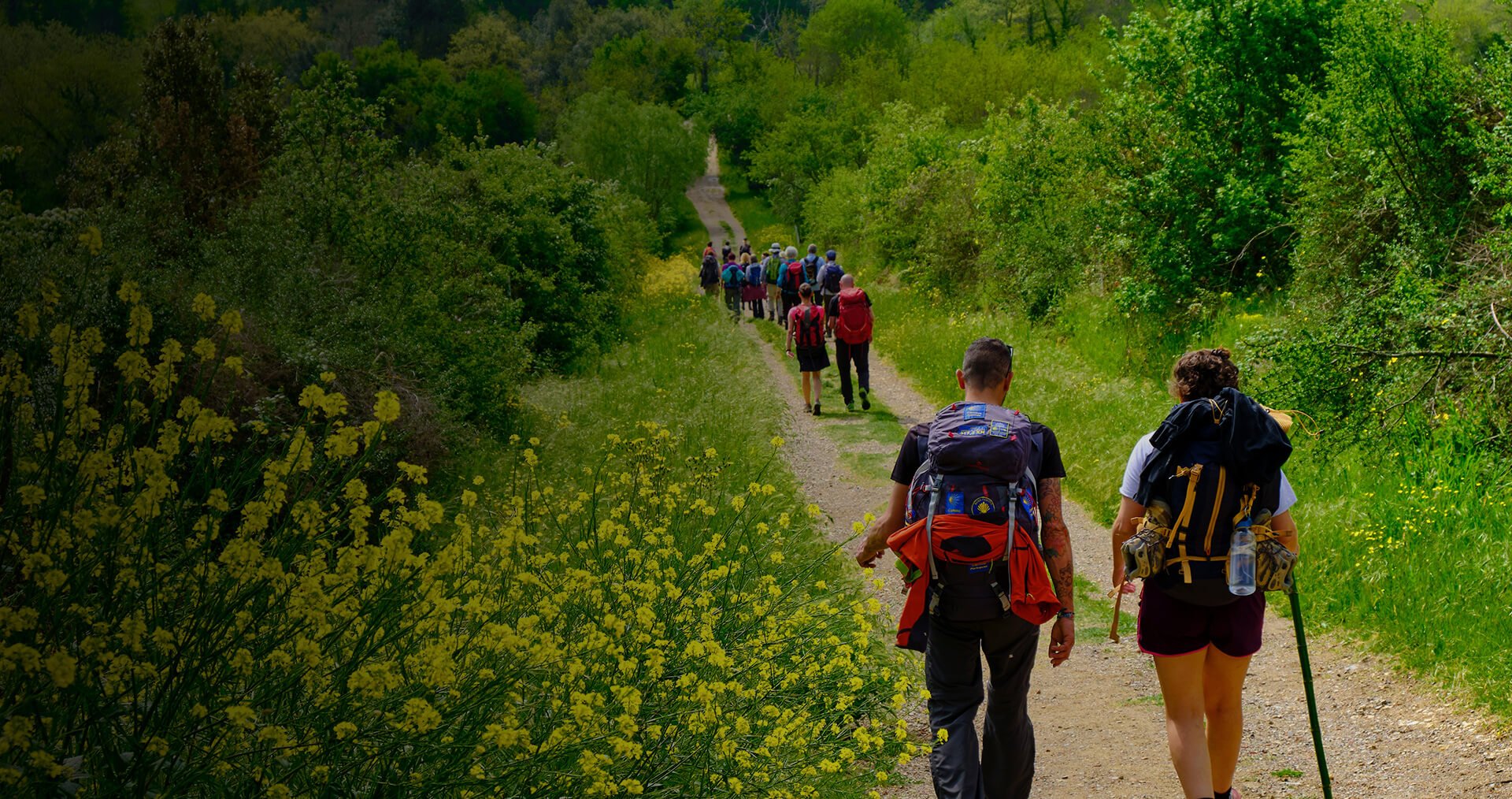
On May 2nd, Pilgrims to Rome volunteers Julia Lewis and Alex Knox led a guided walk along a section of the Francigena Britannica, from Dartford to Shoreham. This was the first in a series of walks that ‘Pilgrims to Rome’ is organising along the Britannica, as they continue to build bridges with local communities and engage local interest. On a beautiful spring day, the group were treated to enthusiastic welcomes all along the route, and were delighted to see how this new extension of the Via Francigena is capturing the imagination.
Ahead of their walk, the group gathered at Dartford’s Holy Trinity Church, where they were met by Revd Jane Kustner. Founded in 1080, and situated some 15 miles from London Bridge, the church has long been a key stopping point for pilgrims. Numbers were so high in the 13th century that Holy Trinity was expanded to include a chapel dedicated to St Thomas Becket. You can still see Becket depicted in a stained glass window, while there is a remarkable 15th century fresco of St George and the dragon – a rare surviving example of medieval wall painting, which was whitewashed during the Reformation, remaining hidden for three centuries before its rediscovery by builders three centuries later. Revd Jane sent everyone on their way with a traditional pilgrim blessing.


The name ‘Dartford’ originated as ‘Darent Ford’, and it has been a key crossing point of the River Darent since Roman times. The Darent is a rare chalk stream, one of only 200 in the world, and the Britannica follows its gentle course throughout this stage. An hour’s walk brought the group to St Margaret of Antioch Church in Darenth, where they were greeted by Revd Emma Young and treated to refreshments. St Margaret’s is thought to be the third oldest church in Kent, and the sixth oldest church in the whole UK! Its Norman font is still in use, and you can easily make out red tiles in the walls that were repurposed from local Roman villas. The parish was acquired by Christ Church, Canterbury, in the year 940, and so at one point was among the holdings of Sigeric – the Archbishop of Canterbury whose journey to and from Rome in 990 remains the key source for the modern Via Francigena.
Pressing on, the group passed through South Darenth – notable for its Victorian railway viaduct and large industrial chimney, which dominate the skyline here – and reached their lunchtime stop at Farningham. The village is home to The Lion, one of the most attractive country pubs on the Britannica, with its beer garden sloping down to the river, and another Grade 1 listed church, St Peter & St Paul. Charles Dickens is known to have visited Farningham on trout fishing trips, while the earliest recorded landlord here is St Alfege. Like Sigeric, Alfege was Archbishop of Canterbury, and also travelled the Via Francigena to Rome in order to receive his pallium, although Alfege was later marytred in Greenwich in 1011. The Britannica passes the church dedicated to him there.
Farningham marks the entrance into the Darent Valley, a sublime stretch of the Britannica. Here, walkers follow a raised chalk path, from which they gain sweeping views eastwards and south along the valley. Plans to build an airport through Darent Valley were fortunately never realised, and so this stunning landscape has been preserved for future generations. Flint and other tools indicate that our Neolithic ancestors made homes here, while several Roman sites have been unearthed in the valley, including Lullingstone Roman Villa – now an English Heritage site, which pilgrims pass on the Britannica.
As will be becoming clear, there is a wonderful concentration of history along this section of the path, and Eynsford is no exception. Although pilgrims must slightly deviate from the path in order to reach the town centre, this charming Kent riverside town, with its 900 year old church, St Martin of Tours, makes for a memorable diversion. Here, the group was again warmly received at the church, and heard how the parish played an important role in the story of St Thomas Becket, when the Archbishop clashed with William de Eynsford in 1163 over who had the right of appointment here. The clash escalated Becket’s conflict with King Henry II, and contributed to his exile from England the following year.
Another stretch of board skies and chalk path led the walkers to Lullingstone Castle, where they were welcomed by its current custodian, Sarah Hart Dyke. This historic seat, which has remained in the family’s possession since the 15th century, once played host to Henry VIII and Anne Boleyn. Julia and Alex were able to share with Sarah Hart Dyke one of a recently commissioned set of Francigena Britannica tiles. These were produced by Karen Slade, a medieval tile maker, and will soon be occupying key positions along the route.
Shoreham bookends the Darent Valley, and here – after a final stretch of the Britannica through hop fields and vineyards – the group finished their day’s walk. In the church, they were welcomed with a pot of tea, and afterwards treated to a tour. Highlights here include the church’s pre-Reformation rood screen, and a view of Shoreham’s famous World War 1 memorial, an enormous white cross cut into a chalk hillside. Pilgrims on the Britannica will discover a similar memorial, further along the path, in Lenham – though Shoreham is proud that its cross came first. War looms large here. During World War 2, Shoreham became known as ‘bomb alley’, an unfortunate title owing to this being the most bombed rural parish in Britain. Yet, today it serves as a picturesque stepping stone on the path to Canterbury. The artist Samuel Palmer lived here and immortalised Shoreham and its surrounding landscape in vivid watercolours. He described Darent Valley as the “Valley of Vision”, and anybody walking this section of the Britannica is sure to be struck by its beauty.
Pilgrims to Rome will be organising more walks along the Francigena Britannica in due course. Please look out for details on our website and in future newsletters.


